
Every once in a while, you stumble across a small detail that makes you go, Wait a second… that’s not right. For me, that moment came while reading the Wikipedia page for my favorite video game, Final Fantasy VII Rebirth. So for this week’s assignment, I decided, why not! I’ll edit my favorite game’s article.

I’d been on a nostalgia spree—watching old cutscenes, reading developer interviews, and browsing fan forums—when I clicked over to the game’s Wikipedia page. Wikipedia has always been my quick go-to for facts, so I expected the page to be a pristine archive of accurate info. But as I skimmed the “Development” section, one detail jumped out like a random battle encounter: the release trailer date was wrong.
I knew this because I’d watched that trailer live, heart pounding as Cloud and Sephiroth lit up the screen. That date was burned into my brain. I double-checked against an article from Wired that confirmed my memory, and sure enough—the Wikipedia page was off.
Instead of charging in and editing it outright, I went to the Talk tab to follow what the assignment asked of me. I posted a note explaining the error, linked to the Wired source, and suggested the fix.
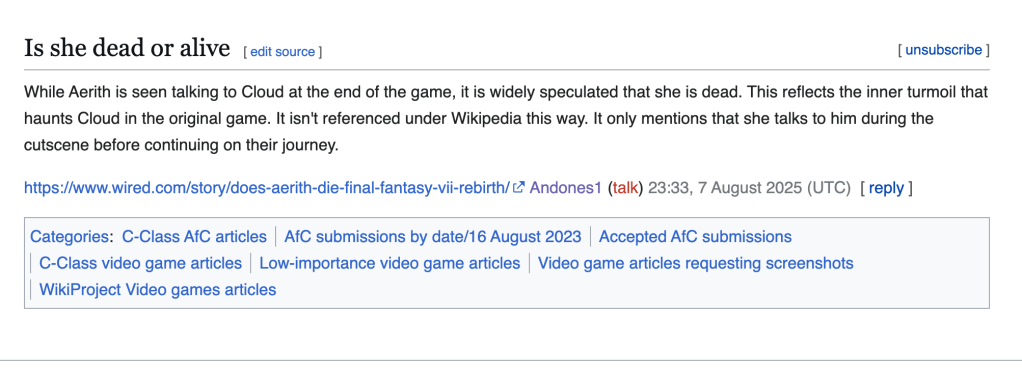
Not quite. A few hours later, I checked back and saw… my change was gone. Someone else had reverted it, saying another source they preferred listed the original (incorrect, in my opinion) date. I reiterated my point and re-linked the Wired article, but the edit war was on. Back and forth it went—my source vs. theirs—until eventually, the version without my correction stuck.
Dont believe me? Look for yourself!
https://en.wikipedia.org/wiki/Final_Fantasy_VII_Rebirth
At first, I was annoyed. I’d done my homework. I had a reputable source. But then it hit me; Wikipedia isn’t a monolithic “truth machine.” It’s a living, breathing collaboration shaped by countless editors, each with their own interpretations of what’s valid and what isn’t. When you’re dealing with media events like game trailers, especially ones reported differently by various outlets, facts can be more slippery than they seem.
I still love Wikipedia. I still trust it for quick look-ups. But this experience taught me it’s not always a place of pure fact, it’s a consensus, sometimes influenced by subjectivity and the many interpretations people bring to the table.
So, the next time I read a Wikipedia page, especially on something I’m passionate about, I’ll remember: it’s not just a record of facts, it’s a record of what people agree the facts are… at least for now.
 MIke's Info Bytes Blog
Leave a comment